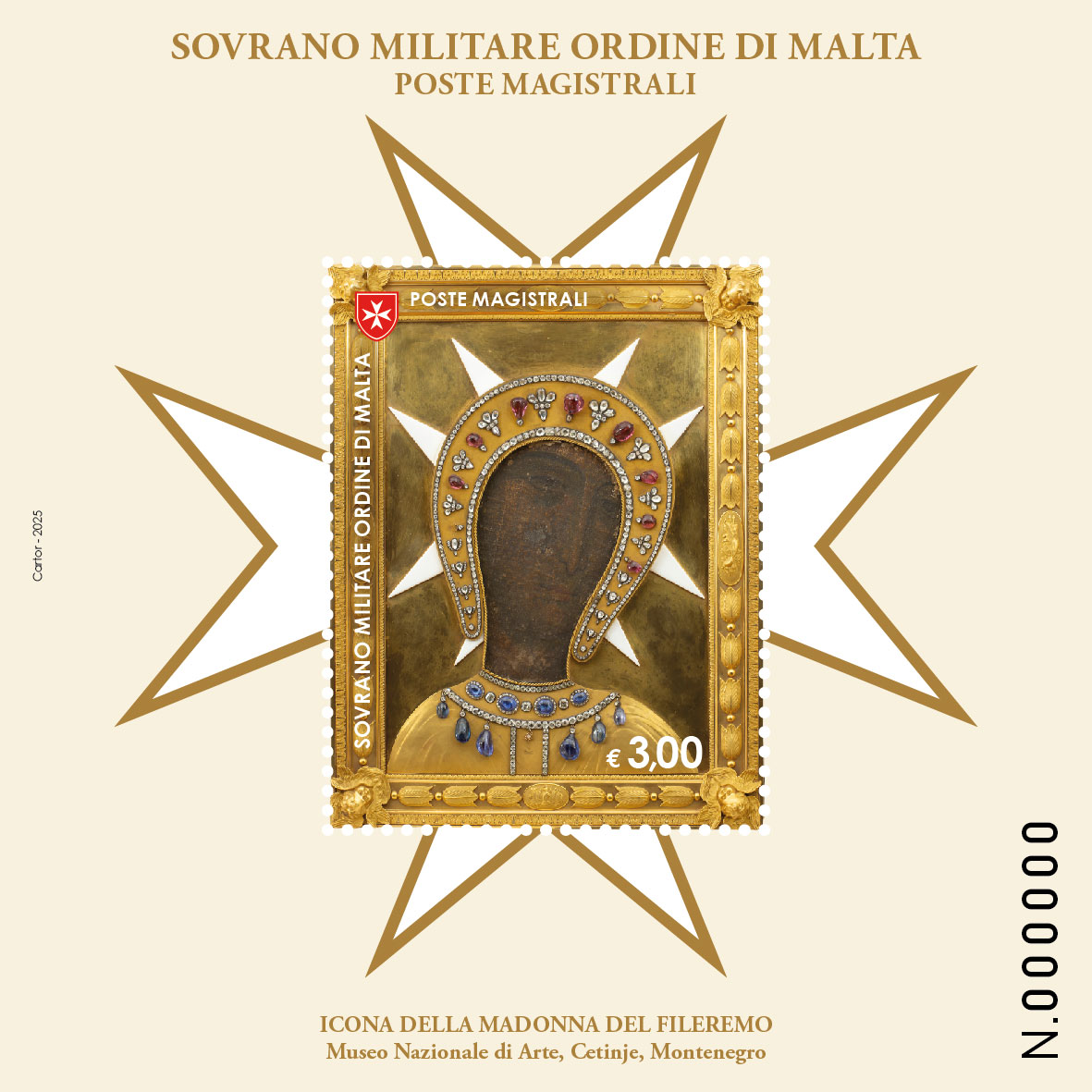
The stamp was printed by Cartor Security Printers in France using the offset technique on white, non-fluorescent paper with polyvinyl adhesive. The sheet measures 100 x 100 mm, while the stamp itself is 40 x 52 mm, with perforation 13 and four-color printing.
At the center of the sheet is the original icon of the Madonna of Philermos, preserved in the National Museum of Art in Cetinje. The inscriptions on the stamp read: “Sovereign Military Order of Malta” and “Poste Magistrali,” accompanied by the Order’s coat of arms and the stamp’s face value.
The story of the Madonna of Philermos: from lost to found, an icon that survived centuries
The icon of the Madonna of Philermos is one of the holiest and most valued relics of the Order of Malta, symbolizing Marian spirituality and the Order’s historical events through the centuries. Its first historical references place it on Philermos Hill in Rhodes between 1306 and 1310.
After the loss of Rhodes in 1523, Grand Master Fra’ Philippe de Villiers de l’Isle-Adam transferred the icon along with other important relics: the right hand of Saint John the Baptist and a fragment of the True Cross. The icon traveled through Italy: Messina, Naples, Civitavecchia, and Viterbo, where it was carried in processions and kept in churches, until it was transferred to Malta in 1530.
In Malta, the icon was first placed in the Church of Saint Lawrence in Birgu, then in the Church of Santa Maria della Vittoria in Valletta, and finally in the Co-Cathedral of Saint John, where it remained for over two centuries.
During the Napoleonic occupation of Malta in 1789, Grand Master Fra’ Ferdinand von Hompesch saved the icon and moved it to Trieste, and then via Balì Giulio Litta to Russia, where Tsar Paul I received it as a relic of the Order. The icon then resided in Gatchina near St. Petersburg, and later in the Winter Palace in St. Petersburg and the Kremlin in Moscow.
After various transfers through the hands of European rulers, the icon arrived in Belgrade, at the Royal Palace in Dedinje, where it mysteriously disappeared during the German bombing in 1941.
During World War II, rumors emerged that the icon might have been in the Ostrog Monastery in Montenegro, supposedly moved there for protection from war damage. However, an inspection conducted by the Grand Master of the Order of Malta, Fra’ Ludovico Chigi Albani, did not confirm the icon’s presence in the monastery, though the idea contributed to the legend of its mysterious fate and decades-long search.
The first copy was made in 1925 by order of Tsar Nicholas I of Russia. This copy was placed in the restored sanctuary on Philermos Hill, under the care of the Franciscans from Assisi, and remained in Italy when Rhodes passed under Greek rule in 1948. Today, it is kept in the Basilica of Saint Mary of the Angels in Assisi, where the knights and dames of the Order of Malta make a pilgrimage at the beginning of September.
The second copy was made in 1931, modeled after Nicholas I’s first copy, and decorated with a frame inscribed with “Ave Maria.” Initially placed in the Cathedral of Saint John in Rhodes, it was later transferred to the chapter hall on Philermos Hill, where it remains today.
Thanks to the perseverance of the Italian researcher Giovannelli Bertè Ferraris di Celle, the original icon was finally found in 1997 in Cetinje, Montenegro, and its authenticity confirmed by Montenegrin and religious authorities.
In 2004, Grand Master of the Order of Malta, Fra’ Andrew Bertie, led a pilgrimage to Cetinje with a delegation of the Order, paying homage to the icon and other relics: a fragment of the True Cross and the hand of Saint John the Baptist, preserved in the Orthodox Monastery of the Nativity of the Virgin in Cetinje.
Today, the icon of the Madonna of Philermos remains a symbol of the Marian spirituality of the Order of Malta and an emblem of its historical events. Knights and dames of the Order continue to honor it as their patroness, celebrating it solemnly on September 8 each year worldwide.